
Introduction
Nurse practitioners have emerged as one of the most desirable and fastest-growing professions in the United States (U.S.) healthcare workforce. Ranked the number one job in the U.S. from 2024-2026 by the 2024 U.S. News & World Report, NPs represent a critical pathway for addressing healthcare shortages, particularly in underserved and rural communities (AANP, 2026). The Association of American Medical Colleges (2024) projects a national shortage of up to 86,000 physicians by 2036, including between 20,200 and 40,400 primary care physicians. Despite this continued growing demand, the infrastructure supporting NP education has struggled to keep pace. NP programs across the country face increasing pressure to produce competent, practice-ready graduates while simultaneously struggling with worsening shortages of qualified clinical preceptors.
The preceptor shortage produces measurable downstream consequences for student progression and program completion. In a survey of 334 NPs practicing in Texas, identifying a preceptor was the most frequently cited barrier to clinical placement (33%), with 46% of NPs stating they were required to find placements independently. In addition, approximately 60% of practicing NPs stated that they are not currently precepting students (Gigli & Gonzalez, 2022). Doherty et al. (2020) conducted a national survey of NP program directors across the United States to examine the clinical placement processes from an institutional standpoint. The study’s findings were similar: providing quality clinical sites and preceptors was one of the greatest challenges for NP programs, and the burden of securing placements often fell on students themselves with 40% of students having to find their own preceptors.
The shortage of preceptors does not operate in isolation; it directly shapes the quality of the clinical education students receive. When programs struggle to secure enough preceptors, students may be placed with clinicians who lack formal preparation for the teaching role or who cannot devote adequate time to instruction amid competing clinical demands. The literature documents a clear chain connecting the erosion in the consistency and quality of preceptorship to negative student outcomes, alongside a broader, well-established gap between NP education and practice readiness.
Clinical Preceptors
Clinical Preceptors play a unique and vital role in NP education. Preceptors serve as hands-on mentors and role models within the clinical environments, where the complexity of patient care cannot be simulated. The American Association of Colleges of Nursing (2026) recognizes preceptors as essential to translating didactic, academic preparation into clinical competence, where knowledge is met with the acquisition of critical thinking and skills. However, the demands placed on preceptors, many of whom receive little to no formal preparation for their teaching roles, have become increasingly burdensome. Lofgren et al. (2021) found that preceptors reported significant challenges balancing clinical productivity with student supervision, stating time constraints and lack of institutional support as primary impediments. McCann et al. (2024) expanded on these findings, reporting that preceptor motivations have grown increasingly intrinsic- driven by personal enjoyment, professional obligation, and a desire to mentor future colleagues - even as external barriers have intensified, including reduced clinic throughput when supervising students and inadequate recognition from academic programs.
The Current Literature Review
The purpose of this literature review was to critically examine the current evidence on structured preceptorship models in NP education and to evaluate their relationship to NP student clinical competence and preceptor productivity. Through thematic synthesis of the included literature, the review sought to derive a set of evidence-based best practices for structured preceptorship, organized according to three themes identified during analysis: preceptor support and productivity, structured communication models and assessment frameworks, and student outcomes. In doing so, this review aimed to establish a foundation for an integrative preceptorship model - one that not only improves student clinical competence but also strengthens, sustains, and retains the preceptor relationships essential to the continued viability of NP clinical education.
Methods
A systematic search of CINAHL (via Wiley Online Library) and PubMed was conducted for literature published between 2019 and 2026. Search terms included nurse practitioner, clinical education, clinical preceptorship, structured preceptorship, preceptor productivity, NP student competence, student competency, preceptor development, role transition, advanced practice nursing, and were combined using Boolean operators (AND, OR, NOT) to refine results. Four primary database searches yielded 644 records, with an additional 15 studies identified through other methods, including supplementary PubMed searches, citation searching, and hand-searching of reference lists.
Inclusion and Exclusion Criteria
Studies were eligible for inclusion if they addressed structured preceptorship, preceptor productivity, clinical competency assessment, NP role transition, or graduate outcomes within NP or advanced practice registered nurse (APRN) education. Sources were limited to English-language publications relevant to graduate-level clinical training. Articles were excluded if they focused on undergraduate education, clinical nurse specialists rather than NP/APRN education, new graduate RN (rather than APRN) populations, or onboarding and residency experiences. Additional exclusions encompassed publications falling outside the review’s central thesis, such as social determinants of health, artificial intelligence in APRN education, APRN role implementation, and competency mapping.
Screening and Selection (PRISMA)
Screening followed PRISMA 2020 guidelines. Records were assessed by title and abstract, followed by full-text eligibility review. Two reports were excluded - one with a new graduate RN rather than APRN/NP focus, and one excluded for translation-related reasons that rendered it unusable for the review. This process yielded 13 included studies from database searches and 15 from other methods, for a total of 28 included studies (Page et al., 2021).
Quality Appraisal
All 28 included sources were critically appraised using the Melnyk and Fineout-Overholt (2023) hierarchy of evidence, which ranks evidence from Level I (systematic reviews and meta-analyses) through Level VII (expert opinion). The included literature clustered predominantly at Levels IV through VI, reflecting a body of scholarship that is largely descriptive, developmental, and exploratory rather than experimental. See the Appendix.
Synthesis Approach
Synthesis was conducted by the authors using a constant comparative approach in which findings were grouped by shared conceptual content and examined for patterns and divergences. Claude (Anthropic, 2025) was used to assist with organizing and formatting the synthesis outputs, including the table of evidence and thematic synthesis table; it was not used to generate findings, appraise evidence, or make inclusion decisions.
Results
Three themes emerged and structured the synthesis: preceptor support and productivity (14 articles), structured communication models and assessment frameworks (8 articles), and NP student outcomes (6 articles). The themes are summarized below.
Theme 1: Preceptor Support and Productivity
This theme was the most heavily represented in the literature, addressed by fourteen of the included sources. See Table 1. A consistent finding was that NP preceptors frequently assume the teaching role without formal preparation, with clinical teaching identified as a distinct competency requiring targeted development (McNeil & Jakubisin Konicki, 2021). Studies evaluating structured preparation reported favorable outcomes, where formal preceptor training programs produced measurable gains in preceptor competency and confidence (Maldonado et al., 2024), an interprofessional work-group approach enhanced teaching effectiveness and engagement (Li Sharpe et al., 2024), and a theory-based survey grounded in the Integrated Behavioral Model provided a validated means of assessing preceptor readiness (DeClerk & Parks, 2025).
Productivity emerged as a central and recurring barrier. Reduced clinical throughput, lost patient flow and income, time burden, and administrative load were repeatedly identified as the primary deterrents to precepting (Lund et al., 2024; McCann et al., 2024; Wiggins et al., 2025), with the COVID-19 pandemic intensifying these pressures and adding emotional exhaustion to the role (McCann et al., 2024). The preceptor shortage itself was shown to create a bottleneck in NP education: in one survey, 61% of students rated the difficulty of finding a preceptor at the highest end of a ten-point scale, a barrier directly associated with delayed graduation and increased student cost (McInnis et al., 2021). Proposed solutions included recognition programs, financial remuneration, scheduling flexibility, and accommodation of preceptors’ clinical responsibilities (Henry-Okafor et al., 2023). Institutional support and clear faculty communication were consistently identified as facilitators of preceptor satisfaction (Lofgren et al., 2021; Todd et al., 2019), while academic-practice partnerships strengthened the consistency of clinical placements (Halverson et al., 2026).
Theme 2: Structured Communication Models and Assessment Frameworks
This theme was addressed by 8 of the 28 sources and represented the most rapidly developing area of the literature, characterized by the emergence and validation of formal frameworks adapted from graduate medical education. See Table 1. The EPAs are units of professional practice that a trainee can be entrusted to perform independently once they have demonstrated the requisite competence, translating broad competencies into observable, assessable clinical tasks. EPAs were shown to standardize performance expectations and create a shared language between students and preceptors across diverse educational contexts (Han et al., 2026; Moore et al., 2024).
The PRIME-NP model represented a second major contribution. A competency-based framework that defines the domains of NP performance and pairs them with criterion-referenced evaluation, PRIME-NP was validated and demonstrated interrater reliability for an associated Objective Structured Clinical Examination (OSCE) rubric (D’Aoust et al., 2024), with subsequent work demonstrating its application to curriculum development (Slyer et al., 2025).
Structured clinical communication tools also appeared in the evidence. The SNAPPS model is a learner-centered, six-step case-presentation framework that guides students to actively reason through a case using summarization, narrowing, analysis, probing, planning, and selection to report findings to the preceptor. The SNAPPS model was found to reduce student anxiety during preceptor presentations while strengthening clinical reasoning and promoting self-directed learning (Castillo & Chaplin, 2026).
The Cognitive Preceptorship model applies the principles of cognitive apprenticeship using modeling, coaching, scaffolding, and fading to facilitate the NP role-transition process. It offers a framework for scaffolding cognitive load as students move toward independent practice (Pleshkan & Boykins, 2022). Diagnostic reasoning, identified as a core competency, was found to be essential but inconsistently taught and assessed, with validated assessment tools remaining underdeveloped (Burt et al., 2025; Smith et al., 2025).
Theme 3: NP Student Outcomes
This theme was addressed by 6 of the 28 included sources and was the most outcome-oriented, linking the structure and quality of clinical training to graduates’ readiness for practice. See Table 1. The quality of supervision during the clinical experience was found to matter more than the volume of hours, with supervised time alongside expert preceptors perceived as more educationally valuable than unsupervised hours (Leonardsen, 2023). This finding gained added significance amid the unresolved debates over clinical-hour adequacy (Buonocore & Horahan, 2026). Role transition emerged as a period of vulnerability, where structured, psychologically safe preceptorship experiences demonstrated strong association with successful transition to practice (Pleshkan, 2024), and pandemic-era training disruptions were shown to have lasting effects on new graduate confidence and readiness (Best-Rhodes, 2026).
Summary of Findings
Across all three themes, structure emerged as the single most important operative variable. Many of the frameworks in the review relied on structure to produce positive results, moving the focus away from ad hoc arrangements. The distribution of evidence, weighted most heavily toward preceptor support and productivity (approximately fourteen sources), followed by communication and assessment frameworks (approximately eight) and student outcomes (approximately six), reflects a field that has invested substantially in understanding the preceptor role and the tools of assessment, while leaving the explicit relationship between structured preceptorship and preceptor productivity comparatively underexamined. No widely adopted model simultaneously addresses student clinical readiness and preceptor productivity within a single, cohesive framework. This gap carries real consequences: preceptors who feel overburdened and underrecognized withdraw from the talent pool, and students who receive inconsistent or misaligned supervision enter independent practice underprepared (Lofgren et al., 2021; McCann et al., 2024; Pleshkan, 2024). This gap represents both a limitation of the current evidence and the primary opportunity for the creation of an integrative, productivity-conscious model that can be tailored to our institution and program-specific needs.
Discussion
The evidence presented in this integrative review converges on a message that structured preceptorship is no longer a pedagogical preference but a systemic imperative for the future of advanced practice nursing education. As NP programs contend with rising enrollment and persistent shortages of qualified clinical preceptors, the concerns about ad hoc, unstructured preceptorship arrangements have become untenable (APEA, 2024; Morr, 2019). The literature reviewed here consistently demonstrates that when preceptors are equipped with targeted preparation, embedded within competency-based frameworks, and supported through academic-practice partnerships, both student clinical outcomes and preceptor professional satisfaction improve meaningfully (Maldonado et al., 2024; Todd et al., 2019; Wiggins et al., 2025).
Best Practices
The evidence points to a set of actionable best practices, organized by theme.
-
Preceptor Support and Productivity
-
Formalize preceptor preparation. Treat clinical teaching as a distinct competency, delivered through structured training and validated readiness assessment rather than left to chance (DeClerk & Parks, 2025; Maldonado et al., 2024).
-
Mitigate the productivity costs of precepting. Offer scheduling flexibility, recognition, and remuneration to offset the time and throughput burdens that deter clinicians from taking students (Henry-Okafor et al., 2023; Lund et al., 2024).
-
Cultivate relationships and partnerships for retention. Strong preceptor relationships and academic-practice partnerships sustain the workforce and improve placement consistency (Halverson et al., 2026; L’Ecuyer et al., 2025).
-
-
Structured Communication Models and Assessment Frameworks
-
Embed competency-based frameworks. Incorporate competency-based frameworks similar to EPAs and the validated PRIME-NP model to standardize performance expectations and assessment (D’Aoust et al., 2024; Han et al., 2026).
-
Use structured communication tools. Models such as SNAPPS and Cognitive Preceptorship strengthen clinical reasoning and scaffold the student-preceptor exchange (Castillo & Chaplin, 2026; Pleshkan & Boykins, 2022).
-
Teach diagnostic reasoning explicitly. Make reasoning a deliberate, assessed competency rather than an implicit one (Smith et al., 2025).
-
-
Student Outcomes
-
Prioritize quality of clinical hours. Supervised time with expert preceptors matters more than raw hour counts (Leonardsen, 2023).
-
Structure role transition to be psychologically safe. Intentional, supportive transition experiences improve readiness (Best-Rhodes, 2026; Pleshkan, 2024).
-
Model EBP and prepare for emerging competencies. Recognize that the preceptor shortage and readiness gaps directly threaten graduate competence and timely completion (Ligita et al., 2024; McInnis et al., 2021).
-
Implications
Drawing on competency-based education, scaffolded learning theory, cognitive apprenticeship, workforce productivity science, CCNE quality standards, and NONPF core competency domains, we propose an integrative framework, summarized below as a set of best-practice recommendations, that addresses these gaps and offers a practical model for academic-practice partnerships. We propose that the pilot is first implemented at our institution and, if successful, scaled into the standard NP preceptorship model across the system.
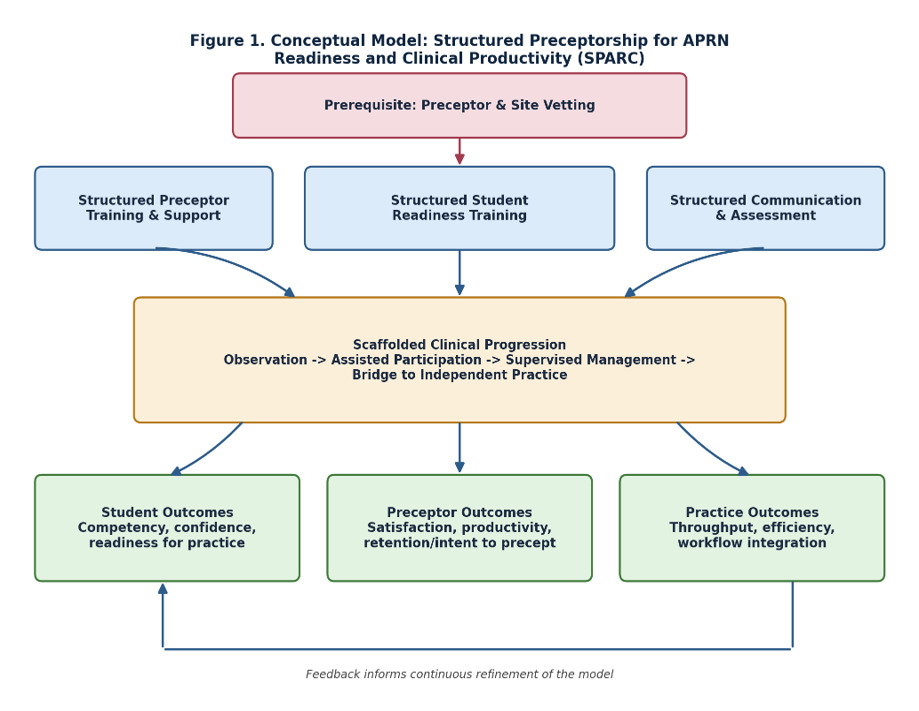
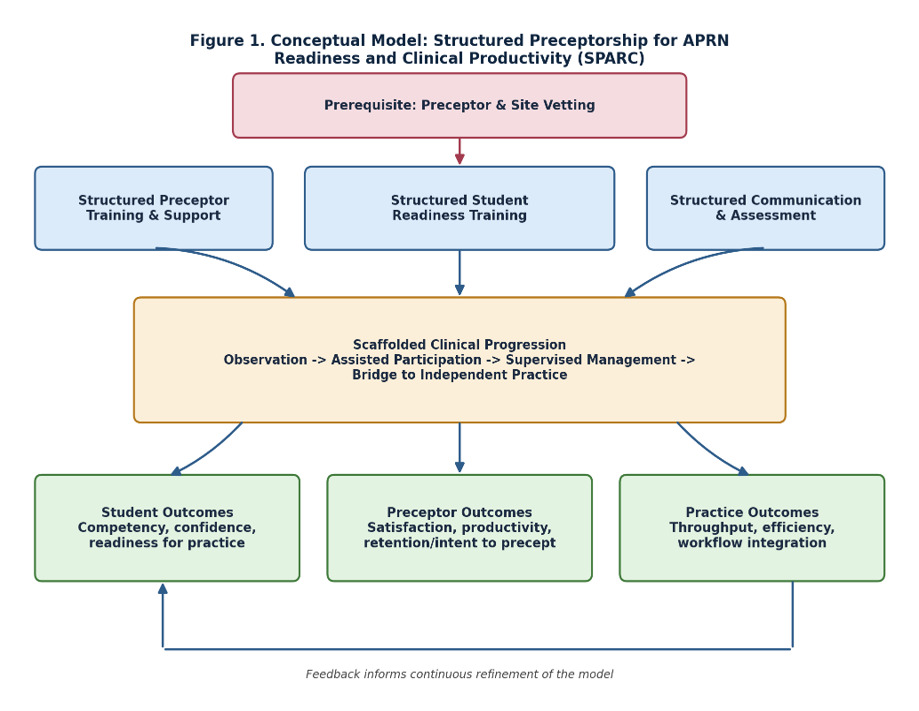
The proposed framework draws from the strongest and most consistent evidence identified in the review and consists of four distinct layers: vetting, preparation, scaffolded implementation, and evaluation. See Figure 1.
-
Vetting
Formal accreditation and regulatory bodies establish minimum qualification thresholds for clinical preceptors. Thus, the initial step in the model is to implement rigorous, systematic preceptor vetting processes that assess the preceptor’s clinical credentials, scope of practice and the broader organizational capacity of the clinical site itself. Sites lacking the patient population diversity, clinical volume, or preceptor engagement needed to fulfill program learning objectives represent a structural mismatch that, left unaddressed, compromises the integrity of the clinical training experience (Halverson et al., 2026; Li Sharpe et al., 2024; McNeil & Jakubisin Konicki, 2021).
-
Preparation
This second layer of the framework consists of intentional preceptor and student training on structured communication and assessment tools. The focal points and considerations at this level are as follows:
-
Require standardized, compensated orientation covering CCNE expectations, NONPF competency domains, and progression benchmarks before any student placement; formal training is associated with greater preceptor confidence and reduced role ambiguity (McNeil & Jakubisin Konicki, 2021).
-
Deliver training asynchronously to accommodate time constraints, the most frequently cited barrier to preceptor development (Morr, 2019).
-
Embed productivity-focused teaching strategies such as workflow integration, delegation, and treating patients while teaching in tandem to directly offset perceived reduction in productivity (Slatyer et al., 2023).
-
Require student pre-placement training focused on EMR navigation, concise documentation, and structured case presentation. Strengthening documentation and presentation skills addresses two of the leading opportunities for improving preceptor-perceived workflow efficiency (McNeil & Jakubisin Konicki, 2021; Morr, 2019).
-
Orient students to productivity-conscious behaviors and the progressive autonomy model before clinical entry, consistent with evidence that pre-experience preparation improves use of clinical time (Benner, 2001).
-
Front-load readiness training to shift onboarding burden away from the preceptor and accelerate meaningful workflow integration (Pleshkan & Boykins, 2022).
-
-
Scaffolded Implementation
-
Implement a stepwise approach grounded in Vygotsky’s Zone of Proximal Development and Benner’s Novice-to-Expert theory to include a four-stage progression- observation, assisted participation, supervised management, and bridge to independent practice (Benner, 1984, 2001).
-
Define explicit expectations at each stage for students and preceptors to standardize progression criteria, consistent with the AACN Essentials (American Association of Colleges of Nursing [AACN], 2021).
-
Reframe the student as a progressively productive contributor rather than a passive learner (Lofgren et al., 2021; McCann et al., 2024).
-
Standardize feedback delivery through real-time coaching, rapid debriefing, and competency checkpoints aligned with NONPF domains to reduce variability in feedback quality (Lofgren et al., 2021).
-
Formalize faculty-preceptor touchpoints to keep clinical experiences aligned with curricular objectives (Markaki et al., 2021; Baptiste et al., 2022).
-
-
Evaluation
-
Include competency-based milestones anchored in NONPF and CCNE standards (Chicca & Shellenbarger, 2023).
-
Use shared evaluation tools across preceptors and faculty to reduce inter-rater variability, mirroring the PRIME-NP model’s use of OSCE (D’Aoust et al., 2024; Slyer et al., 2025).
-
Extend measurement beyond student competency to include evaluation of preceptor satisfaction, perceived productivity, and intent to continue precepting, following the clinical experience.
-
Conclusion
This review represents the initial phase of a broader effort to translate existing evidence into an original, integrative model for implementation at our institution. Rather than simply consolidating frameworks already shown to be effective, the proposed model advances them by explicitly positioning preceptor productivity as a central design element, alongside student competency, communication, and assessment, in support of stronger academic-practice partnerships. The intended outcomes include improved diagnostic reasoning, more consistent competency assessment, greater preceptor retention, and ultimately stronger patient safety and quality of care.