
Background
The nursing program is an intense and comprehensive journey that encompasses both didactic and clinical practice, integrating real-world clinical experiences. Students are required to learn and apply complex subjects, such as pharmacology and pathophysiology, while developing hands-on skills to provide safe and effective patient care. The program’s intensity and fast-paced nature demand resilience, time management, and a strong commitment to succeed in both academic and clinical settings. The pharmacology course is an integral part of the nursing program because it directly impacts patient safety, equips nurses to prevent medication errors, prepares them to educate patients, and pass the NCLEX exam. Pharmacology is a complex course involving pharmacological names, mechanisms of action, side effects, contraindications, interactions, and nursing interventions. Nursing students must understand pharmacokinetics and its impact on all body systems. The complexity of the pharmacology course poses challenges to nursing students, which could be a determining factor in their successful completion of the program and passing the NCLEX-RN exam.
Introduction
Nursing students can effectively overcome the challenges of a pharmacology course through a thoughtfully designed, structured remediation program that offers targeted support and empowers students to succeed. Remediation is “a formal process by which an at-risk student is identified, and an individualized remediation plan is developed with open feedback from both the student and the academic institution.” (Thilges & Schmer, 2020). Remediation encompasses any interventions aimed at correcting and improving study skills. The remediation intervention is designed for students in the course who struggle in both didactic and clinical settings. (Hutton & Krull Sutherland, 2007). The nursing program requires a structured didactic and clinical curriculum, accompanied by proactive remediation plans that are supported by institutional policies. (Shah et al., 2022). The purpose of this article is to share my personal experience developing and refining structured remediation strategies for students enrolled in a pharmacology course. Prior to implementation, a structured remediation process did not exist. This reflection outlines the strategies utilized, the rationale behind each decision, and the lessons learned when addressing student learning challenges. By presenting both successes and opportunities for improvement, this article aims to contribute to the growing dialogue on evidence-based remediation practices that enhance student success and support excellence in nursing education.
Remediation Strategies
Remediation strategies are tailored to meet the needs of prelicensure nursing students and utilize institutional resources. A body of literature exists that focuses on remediation strategies and processes. One effective remediation strategy is called insightful practice. During insightful practice, the educator facilitates students’ insight into their problems, fosters engaging sessions, and creates a remediation plan. (Davey et al., 2015). According to Hauer et al. (2009), elements of a successful remediation program include 1) a screening process; 2) identifying underlying issues and developing an individualized plan of action; 3) providing remediation through instructions, practice, feedback, and reflection; and 4) reevaluation. A collaborative team effort by students, expert educators, university learning specialists, mentors, student counselors, and administrators is essential for effective remediation.
As part of remediation, various educational tools can be used to enhance knowledge. Students prefer diverse and interactive educational tools (Olsen et al., 2023). These tools include reading materials, videos, discussion sessions, seminars, workshops, self-recorded videos, and quizzes, which aim to increase student participation, decrease anxiety, and promote positive outcomes. (Norman-Eck et al., 2023; Sterling-Fox et al., 2020).
Periodic evaluation of the remediation program is necessary to determine whether the set objectives are achieved. (Hauer et al., 2009). The effectiveness of a remediation program can be evaluated through progress in assessment scores, clinical practice observations, or Socratic questions. The remediation team should also provide constructive feedback, both verbally and in writing. Debriefing evaluation findings to the student and maintaining a documentation trail are crucial for the remediation program. All documentation should be kept in students’ academic records for future reference (Sarah & Jennifer, 2011).
Personal Reflections on Remediation for Pharmacology Course
Remediation Process
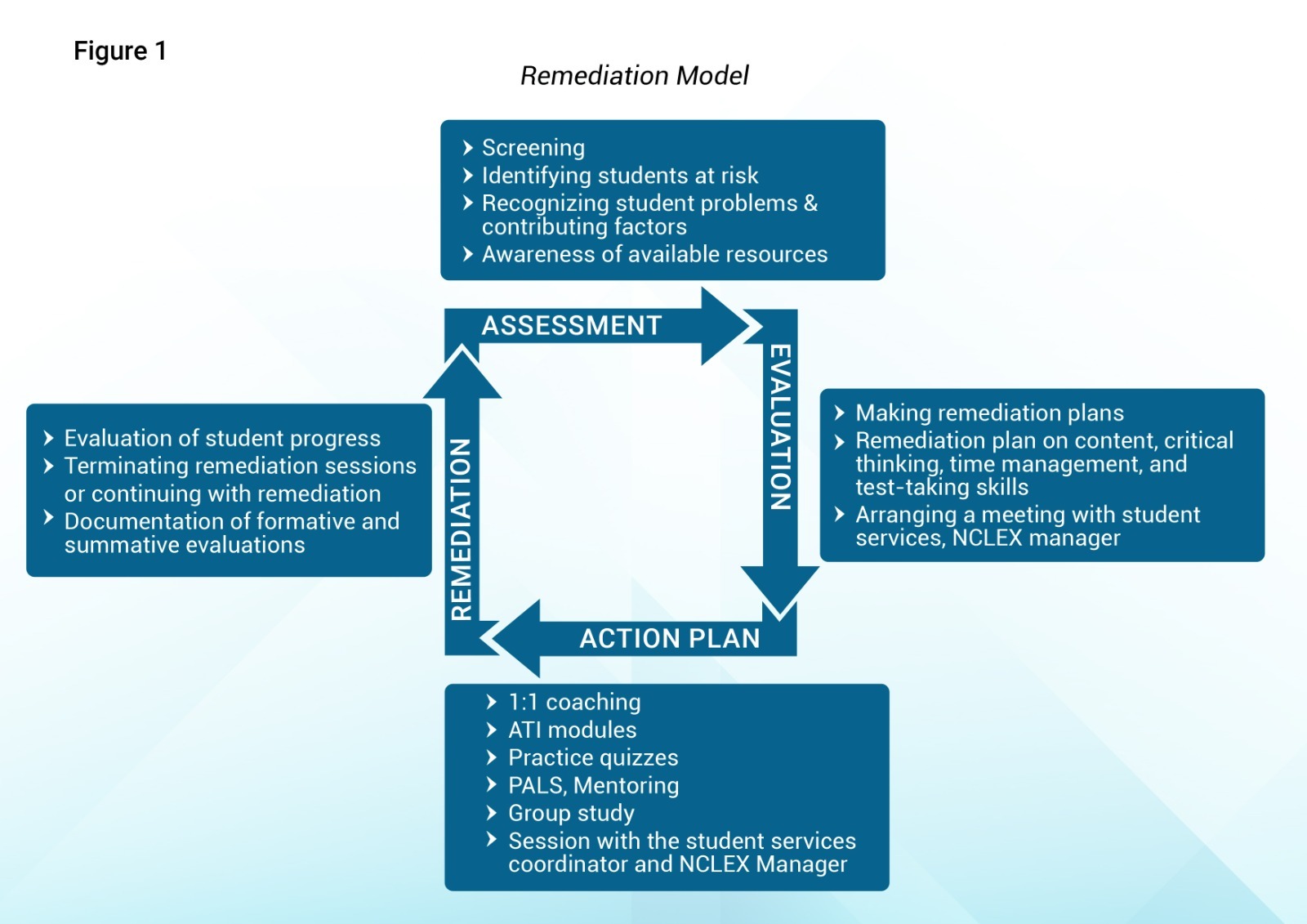
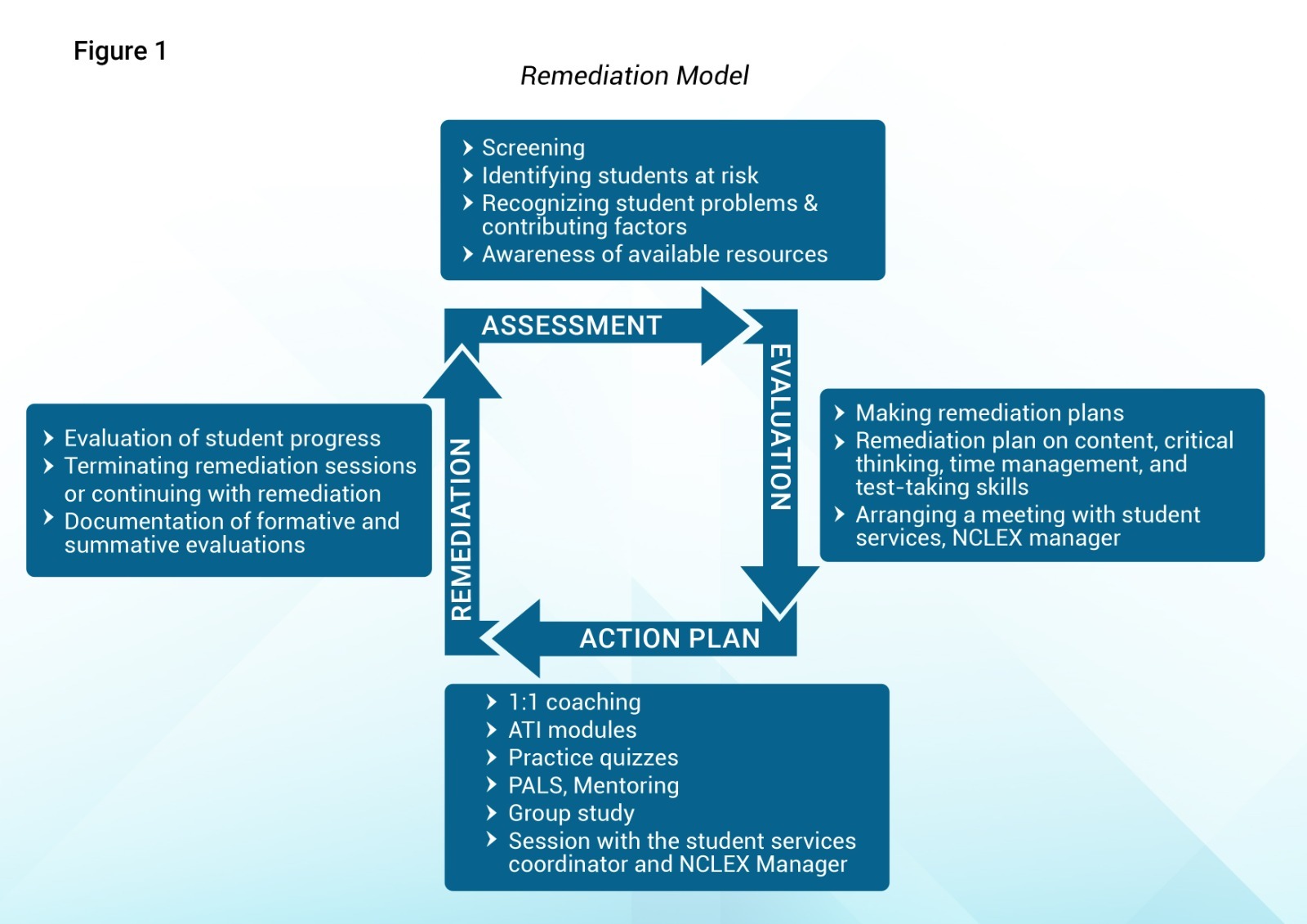
Building on the Nursing Process Model described by the American Nurses Association, which identifies assessment, diagnosis, outcomes/planning, implementation, and evaluation (American Nurses Association, n.d.), an expanded four-step remediation model comprising assessment, creating an action plan, implementing the remediation plan, and evaluation was developed and implemented, as shown in Figure 1. The first step is Assessment, where students are screened to identify those at risk, determine underlying problems, and evaluate available resources. Students with a grade below 76% after the second quiz and the weekly study module were considered candidates for remediation. Incorporating remediation as part of active learning, grades ensured that all students willingly participated in the process. The remediation process begins with a screening form that enables students to reflect on their study habits, identify their strengths and weaknesses, and recognize areas where they need assistance (Tsusaki et al., 2024). During the second step of the Action Plan phase, tailored strategies are developed to address specific needs, focusing on content mastery, critical thinking, time management, stress management, and test-taking skills, while coordinating with student services and the NCLEX specialist. Emphasis was also placed on the research-proven spaced-repetition learning method (Durrani et al., 2024). The third step of the Remediation phase involves implementing targeted interventions such as one-on-one coaching, practice quizzes, group study sessions, and faculty or peer mentoring. Students were also provided with a remediation paper card that included instructions to meet with academic advisors and the NCLEX manager to obtain their signatures, as well as to attend Peer Assisted Learning sessions. Students were awarded active learning points for complying with the remediation card instructions. Finally, in the Evaluation phase, student progress is measured through formative and summative assessments to determine whether to continue or conclude remediation. This cyclical process supported continuous improvement and student success. All formative and summative assessments, along with completed remediation action plans, were documented in student records. Administrative support throughout the process allowed me to implement the remediation strategy with appropriate academic freedom.
Several factors can hinder remediation efforts. Students often cite limited time due to other coursework, personal responsibilities, work schedules, or difficulty navigating remediation resources. Some also perceive the materials as ineffective. Educators face barriers such as limited protected time, heavy workloads, difficulty linking didactic content to practice, and a lack of motivation among some students, all of which challenge successful remediation.
Post remediation, some of the student comments or feedback received during the last session were: “I finally understood how to study different drug classifications, why certain medications are given together, and how to calculate dosages correctly.” “My grades turned around completely. I went from failing the course to passing with a solid B, all because of the extra support I got through remediation.” “I honestly thought about quitting after I failed my first two exams. The remediation process gave me the tools and encouragement to keep going.” “The remediation sessions showed me that the faculty really care about our success. It did not feel like punishment; it felt like they were giving us another chance to succeed.” Overall, student scores and course outcomes improved, and students felt more confident in their pharmacology learning after completing the remediation process.
Remediation in pharmacology courses plays a critical role in supporting academic success. Although formal data on the effectiveness of remediation in pharmacology has not yet been collected, this represents a valuable opportunity for future research. Evidence generated from such studies would help guide targeted interventions and strengthen best practices in nursing education. Both qualitative and quantitative methods could offer meaningful insight. Qualitative research may explore student experiences, perceived barriers, and the emotional impact of remediation, while quantitative data could track test performance, course outcomes, and NCLEX pass rates. Ultimately, structured remediation has significant potential to enhance student success and promote safe, competent nursing practice.
Lessons Learned
-
Remediation in the pharmacology course helped students better understand their learning challenges and develop strategies for mastering complex concepts.
-
Early identification of at-risk students was essential; delayed intervention increased anxiety and reduced confidence.
-
Personalizing remediation to each student’s needs fostered stronger engagement and improved outcomes.
-
Framing remediation as supportive growth rather than punitive correction increased student receptiveness and motivation.
-
Students reported feeling more supported with collaboration among faculty, academic advisors, and the NCLEX manager.
-
The remediation card served as a helpful reminder of available institutional resources.
-
A structured remediation process allowed purposeful use of office hours without requiring additional time.
-
Consistent faculty-student check-ins helped monitor progress, reinforce accountability, and modify learning strategies when needed.
Conclusion
Remediation is vital to nursing education, ensuring competence and confidence among nursing students who will play a significant role in the future healthcare workforce. Addressing student challenges at the earliest helps guide academic success. Remediation strategies should be multimodal, engaging, and rewarding for the students. A structured remediation program requires institutional support with policies and collaboration among faculty, student advisors, academic specialists, and students. Ultimately, nursing educational institutions are ethically responsible for providing competent, compassionate, and well-prepared nurses to meet professional demands and serve our community. Remediation in a nursing program evolves based on the needs of students, with a focus on academic success.